The mathematician and science communicator Prof. Christina Pagel talks about her German family
My father was born in Hamburg in 1937 and had vivid memories of Hamburg during the war. My mother was born in 1941 in the historic port city of Königsberg, now Kaliningrad in Russia, and fled west in January 1945 as the Russian army approached.
After a year of travel, sickness, and refugee camps she and my grandmother made it to Bonn, where they took refuge with my grandfather’s relatives. My grandfather was originally from there. He was a prisoner of war in England and came back a few months after the war ended. My aunt was born in 1946.
A lot of my mother’s family ended up in East Germany, not having made it all the way West before the borders were closed. My mum and my aunt grew up in a bombed-out house in Bonn and were very poor, having left everything behind in East Prussia, but she had a very happy childhood.
My father went to the US to go to high school at the age of 14 (he stayed with his uncle who’d emigrated there in 1937) and didn’t go back to Germany for another 9 years! My dad worked for Reuters and moved a lot for his job – so my brother was born in Geneva, my sister in Brussels, and me (the youngest), in England. My parents moved here the year before I was born, and then never left.
We would go visit Germany at least once a year when growing up, sometimes twice a year. Mostly, we would go visit my mum’s sister – her children were about our age and we would spend every summer rampaging around the woods near their house in the outskirts of Bonn. We’d hike up the Siebengebirge or take boat trips on the Rhine. We’d also visit my grandparents who lived in Kakenstorf, about an hour outside of Hamburg. Because we mostly visited family, we didn’t travel that widely, but I do remember trips in the mountains near Munich, the Schwarzwald and visiting family friends in Stuttgart.
We still have a German family Christmas, celebrating on Christmas eve with carols, the advent candles, dinner and then presents Germany feels like a second home to me still. Random things I love about Germany are the light switches (!), modern furniture, the Rhine, Lübecker marzipan, medieval German towns, Brötchen, proper cycle lanes and a proper German breakfast buffet and the Christmas markets.
I’m a mathematician. I do a very practical branch of mathematics called “Operational Research” which is all about pragmatic problem-solving using maths and data. I do a lot of work using data to help hospitals improve their services for children and adults born with congenital heart disease, and other projects using data and modelling to help intensive care teams care for their patients – for example using data to spot when patients are getting sicker more quickly. I’m hoping to start a big new project in the summer of 2025 working with hospitals, schools, and councils to improve services for severely disabled children.
I was a member of Independent Sage during the Covid pandemic. I was asked to join – at first, I thought they were joking! But I spoke to the then Chair Sir David King and a couple of other members and they reassured me. I had done a lot of work in my “normal” job about communicating data and maths with patients and the public and I hoped that I could contribute those skills to Indie SAGE.
I’ve always been fascinated by history and classical civilisations. When I was 16, I had to choose between science or humanities A-levels and university degree. I decided to do mathematics (and I don’t regret that) but I always loved History and promised myself I would get back to it someday. After my undergrad, I did a 2-year part time Masters in Classical Civilisation and then about ten years later I did another 2-year part time Masters in Medieval History. I loved both of them! There is something very freeing about studying a subject only for your own interest. I feel like I’ve got another one in me but it will have to wait a while as I just don’t have time right now…
Looking to the future, my department is hoping to start a large programme of work soon, improving services for disabled children. We also want to extend our congenital heart disease work into producing resources for patients and front-line staff and new ways of monitoring and communicating outcomes after surgery.
Königsberg
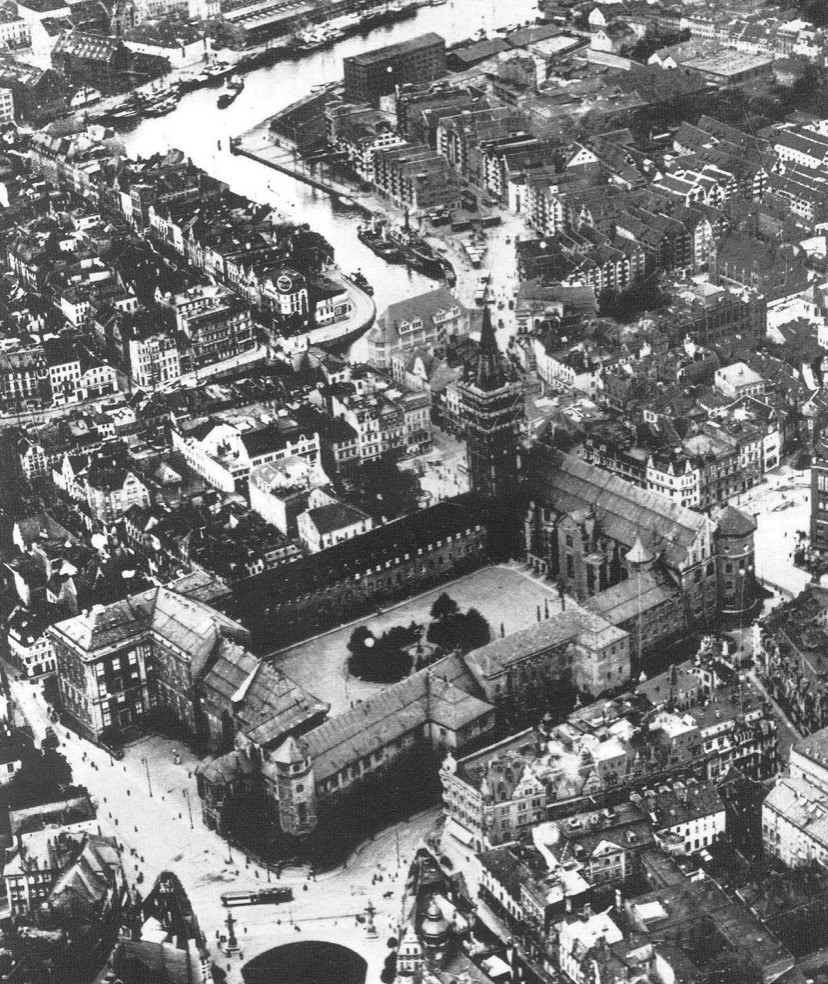
The Baltic port city of Königsberg was founded by Teutonic knights in 1255 and was an important German intellectual and cultural centre. The city was severely damaged by allied bombing in 1944, and it was annexed by the Soviet Union in 1945. Its German inhabitants were expelled and the city renamed Kaliningrad.